Clase 6: Modelos complejos I
Colecciones
Arrays
Arreglos de enteros, booleanos, variables de decisión o floats
array[1..2] of int: costo;
array[1..2, 2..3] of var: sol;

array[1..3,1..2] of float: ejemplo;

ejemplo = [1.2 , 2.0 | 2.0 ,3.0 | 4.2 , 5.3 ];
ejemplo = array2d(1..3, 1..2)([1.2,2.0,2.0,3.0,4.2,5.3])
Conjuntos
- Secuencia de elementos que no se repiten
set of int: HEIGHT = 0..h;
set of var: H;
Enumeraciones
enum Recursos;
enum Colores = {verde, rojo, azul}
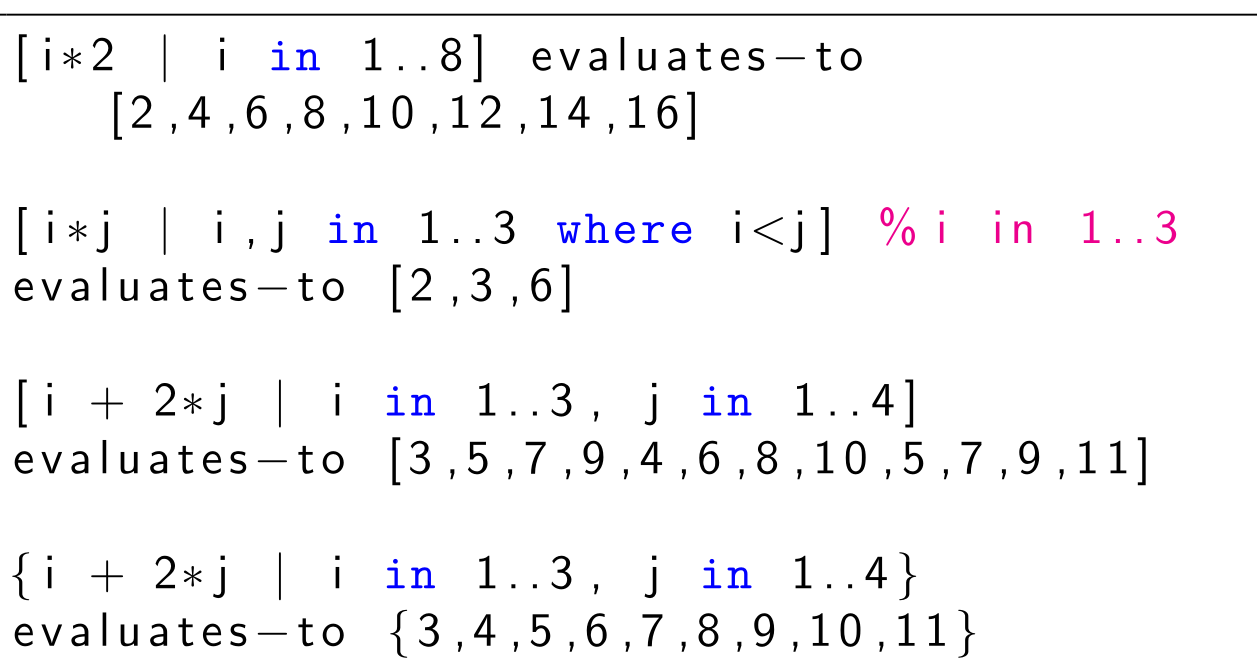
Generadores
List comprenhesion / set comprenhesion
Sirven para generar listas y conjuntos
Funciones de agregación
Que es una función de agregación
Para trabajar con restricciones de tamaño arbritario, nos permiten incluir restricciones de acuerdo a las entradas
MiniZinc provides four aggregation functions for arrays containing Boolean expressions. As we have seen, the first of these, forall, returns a single constraint which is the logical conjunction of the constraints. The second function, exists, returns the logical disjunction of the constraints. Thus, forall enforces that all constraints in the array hold, while exists ensures that at least one of the constraints holds. The third function, xorall, ensures that an odd number of constraints hold. The fourth function, iffall, ensures that an even number of constraints holds.
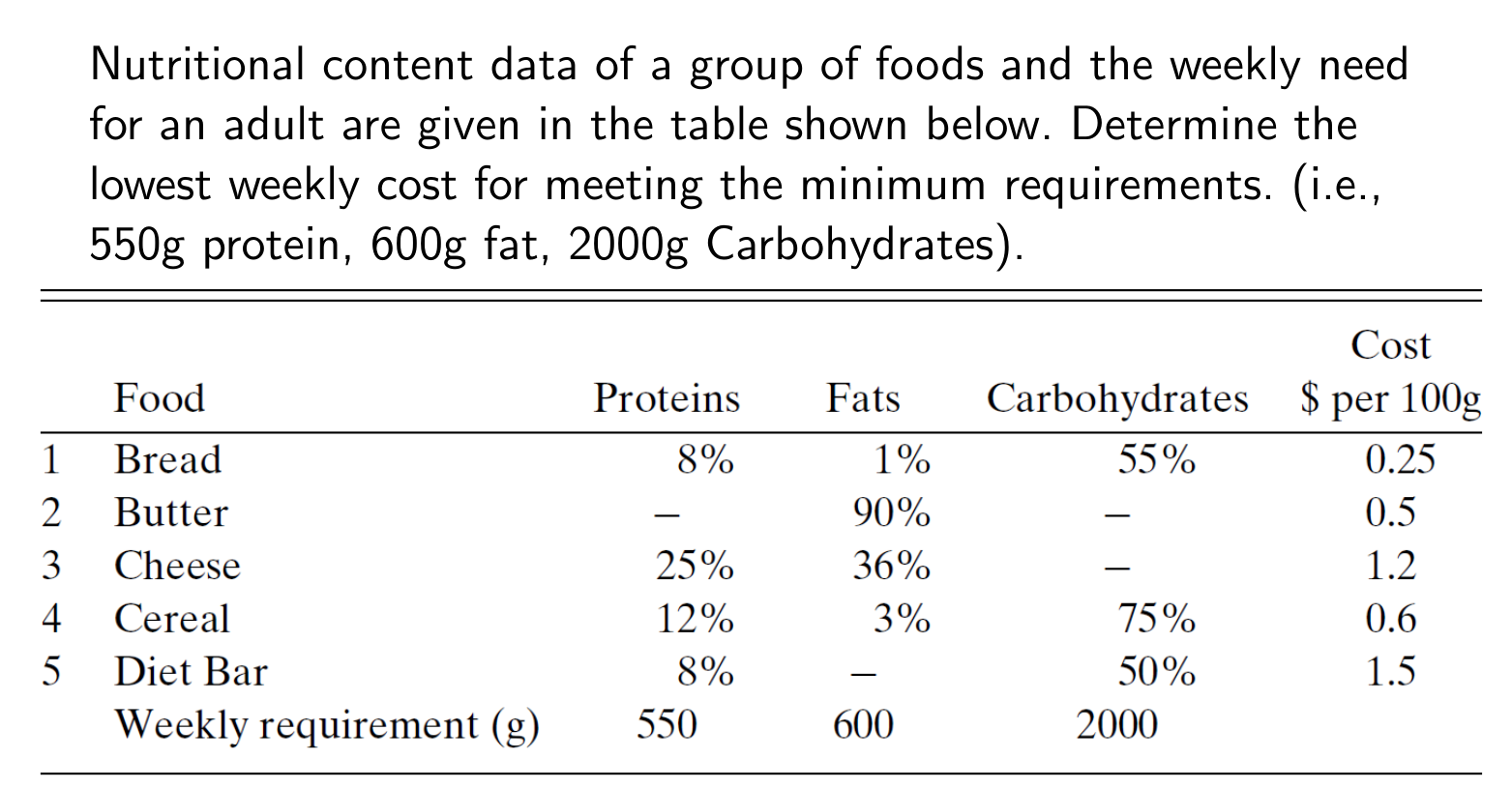
Ejemplo
Escoger COIN-BC
%Modelo con arreglos
enum food = {bread, butter, cheese, cereal, diet_bar};

array[1..5,1..3] of float: nutrients = [| 0.08, 0.01, 0.55 | 0, 0.9, 0 | 0.25, 0.36, 0 | 0.12, 0.03, 0.75 | 0.08, 0, 0.5 |];

array[1..3] of int: req = [550, 600,2000];

array[1..5] of float: costs = [0.25, 0.5, 1.2, 0.6, 1.5];
%Variables de decisión
array[1..5] of var int: prod;
var float: z;

%Restricciones
constraint forall(i in 1..5)(prod[i] >= 0);
constraint forall(i in 1..3)(sum(j in 1..5)(prod[j]*nutrients[j,i]) >= req[i]);
constraint z = sum(i in 1..5)(prod[i]*costs[i]);

solve minimize z;

output[show(food), show(prod), show(z)];
%Modelo con arreglos y carga
int: num_productos;
int: num_requerimientos;
enum food;

array[1..num_productos,1..num_requerimientos] of float: nutrients;

array[1..num_requerimientos] of int: req;

array[1..num_productos] of float: costs;

%Variables de decisión
array[1..num_productos] of var int: prod;
var float: z;

%Restricciones
constraint forall(i in 1..num_productos)(prod[i] >= 0);
constraint forall(i in 1..num_requerimientos)(sum(j in 1..num_productos)(prod[j]*nutrients[j,i]) >= req[i]);
constraint z = sum(i in 1..num_productos)(prod[i]*costs[i]);

solve minimize z;

output[show(food), show(prod), show(z)];
%archivo de datos (dzn)
num_requerimientos = 3;
num_productos = 5;
food = {bread, butter, cheese, cereal, diet_bar};

nutrients = [| 0.08, 0.01, 0.55 | 0, 0.9, 0 | 0.25, 0.36, 0 | 0.12, 0.03, 0.75 | 0.08, 0, 0.5 |];

req = [550, 600,2000];

costs = [0.25, 0.5, 1.2, 0.6, 1.5];
Guardar ambos archivos mzn y dzn en el mismo directorio